
Alpha Bollinger Band Trading Strategy

The Entropy Alpha Strategy is a trend-following model that builds upon the foundational principles of the Entropy trading system. While Entropy primarily uses Bollinger Bands to identify and trade reversions to the mean, the Alpha strategy focuses on capturing the more powerful moves that occur when a market’s primary trend resumes.
This strategy was developed to answer a critical question for traders using mean-reversion systems like the 3BB strategy: what happens *after* a mean-reversion trade is complete, and how can we profit from the larger trend?
A Quick Recap of the 3BB Strategy
Before diving into the Alpha strategy, it’s essential to understand its predecessor, the 3BB (3 Bollinger Bands) strategy. The 3BB strategy is a high-probability mean-reversion setup designed to capture short-term price movements back towards the 20-period moving average (the middle Bollinger Band). It identifies specific candlestick formations at the edge of the bands that signal a temporary exhaustion of momentum.
The core idea is to enter a counter-trend trade with a tight stop-loss, targeting the middle band for a quick profit.
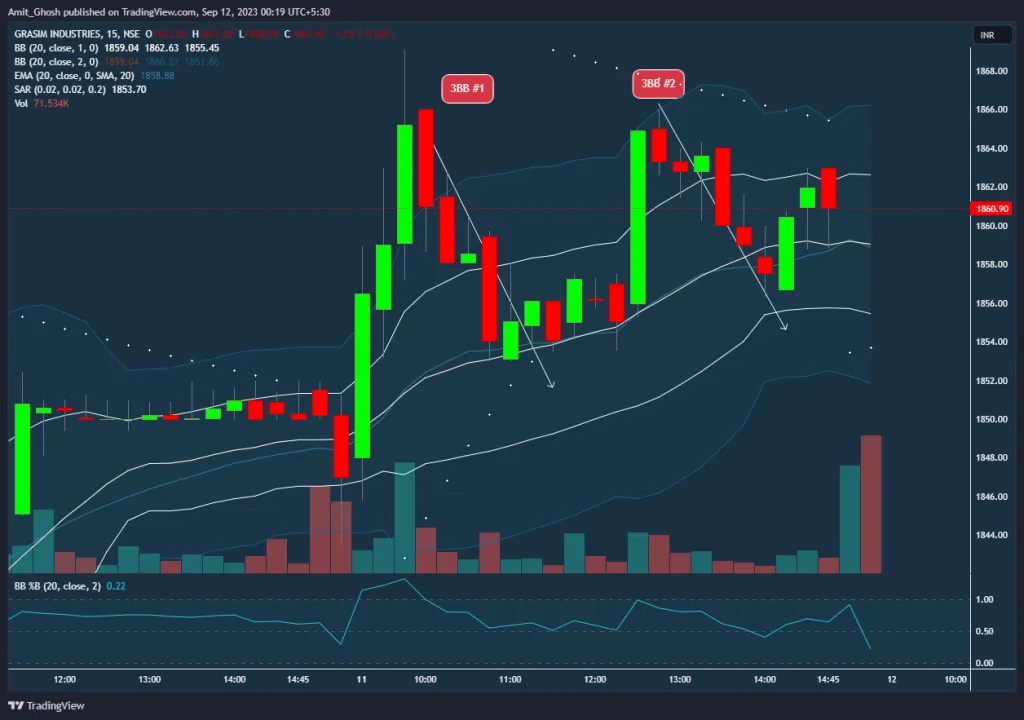
In the GRASIM chart below, we can see two examples of classic 3BB short trades. In both cases, the price touches the upper Bollinger Band, forms a bearish reversal pattern, and subsequently falls back to the 20-period moving average (the dotted line). These are successful, high-probability trades that achieve their objective.
The Limitation of Pure Mean Reversion
While profitable, mean-reversion strategies have an inherent limitation: they are fighting the primary trend. By definition, they capture the pullbacks, not the primary waves of movement.
If we zoom out on the same GRASIM chart, the bigger picture becomes clear. The stock is in a strong, discernible uptrend.
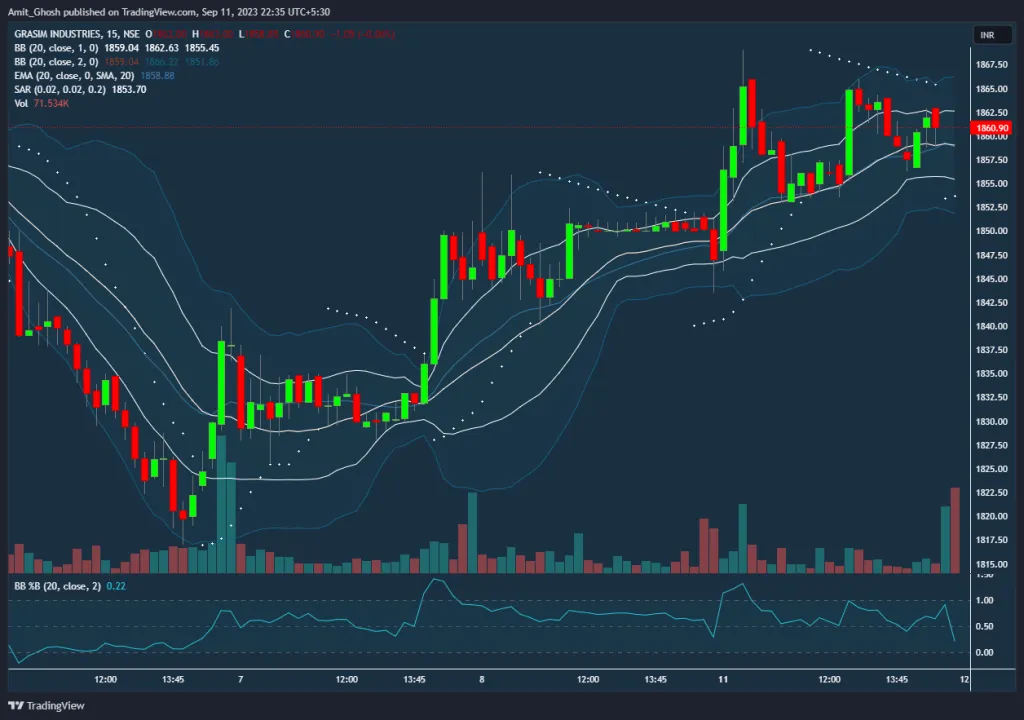
The successful 3BB short trades were merely small corrections within this larger uptrend. After each trade hit its target at the middle band, the stock found support and continued its upward march, eventually breaking to new highs. This leads to two critical questions for the systematic trader:
- What if we could enter a buy trade at the exact moment the 3BB short trade is exited?
- What if we could predict that a 3BB short signal is likely to fail (i.e., hit its stop-loss) and instead take a long trade in anticipation of the uptrend’s immediate resumption?
The Entropy Alpha Strategy is the system designed to answer these questions and exploit these trend-continuation opportunities.
What is the Entropy Alpha Strategy?
The Entropy Alpha Strategy is a trend-following overlay that uses 3BB signals as entry triggers for trading in the direction of the dominant market trend. Instead of trading the reversion to the mean, it trades the resumption of the trend *from* the mean.
There are two primary variants of the Alpha trade:
Alpha Type 1: Entry on 3BB Target Completion
This is the most common and straightforward Alpha trade. The trader waits for a counter-trend 3BB setup to complete its objective.
- In an uptrend, a 3BB short signal appears at the upper band.
- The short trade is either taken or observed.
- The price falls and touches the 20-period moving average (the target for the 3BB trade).
- This touch of the middle band becomes the entry trigger for a long (buy) trade, in alignment with the primary uptrend.
Alpha Type 2: Entry on Anticipated 3BB Failure
This is a more aggressive variant that requires a predictive model. The system anticipates that a given 3BB signal has a high probability of failing.
- In an uptrend, a 3BB short signal appears.
- Instead of going short, the trader immediately initiates a long position, betting that the signal will fail and the uptrend will resume forcefully.
- The stop-loss for the failed 3BB trade becomes the entry trigger for the Alpha trade.
The Rules for the Entropy Alpha Strategy (Long Trade)
- Establish the Primary Trend: The market must be in a clear, confirmed uptrend. This can be defined by price trading above a 50-period or 200-period moving average, or by a consistent pattern of higher highs and higher lows.
- Identify a Counter-Trend Signal: Wait for a valid 3BB short signal to appear at the upper Bollinger Band.
- Determine Entry Trigger:
- Type 1 (Standard): Enter a long position when the price, after triggering the 3BB short, pulls back and touches the 20-period moving average (the middle band). The entry is taken on the close of the candle that touches the middle band.
- Type 2 (Aggressive): Enter a long position if the price breaks above the high of the 3BB signal candle, triggering the stop-loss of the potential short trade.
- Define the Stop-Loss: Place the protective stop-loss below the recent swing low that formed prior to the entry signal. This is typically the low of the pullback.
- Set the Profit Target: The initial profit target is the prior high of the trend. More advanced targets can be calculated using Bollinger Band width or Fibonacci projections, often targeting a risk-multiple (R-multiple) of 2R or greater.
The rules for a short trade in a downtrend are simply the inverse.
Position Sizing with R-Multiples
Effective risk management is paramount. The position size for any Alpha trade should be calculated based on a pre-defined risk per trade (the “R-value”). A common practice is to risk no more than 1-2% of your trading capital on a single trade.
The distance between your entry price and your stop-loss price represents your risk per share (R). The formula for position size is:
For example, assume a trader has a capital of Rs. 5,00,000 and is willing to risk 1% per trade.
- Total Capital: Rs. 5,00,000
- Risk %: 1%
- Risk Amount per Trade: Rs. 5,000
- Stock: NIFTY Futures
- Alpha Entry Price (long): 23,500
- Stop-Loss Price: 23,450
- Risk per unit (R): 23,500 – 23,450 = 50 points
The position size would be:
In this scenario, the trader would buy 100 units of NIFTY futures (equivalent to 4 lots, as the lot size is 25). If the trade hits the stop-loss, the loss will be controlled at Rs. 5,000. A profit target of 2R would be at 23,600, yielding a profit of Rs. 10,000.
The Role of Machine Learning in the Alpha Strategy
The original source mentions Machine Learning, and this is where the “Alpha” truly comes from. While the basic strategy can be traded discretionarily, a data-driven approach uses ML models to increase the system’s edge, particularly for identifying high-probability Type 2 (aggressive entry) trades.
The goal is to build a model that can predict the probability of a 3BB signal failing.
Feature Engineering
An ML model is only as good as its data. For predicting 3BB failure, the model would be trained on historical data with features like:
- Bollinger Band Width: A measure of volatility. Low volatility (narrow bands) often precedes explosive breakouts. The feature could be normalized as .
- ADX Value: The strength of the primary trend. A high ADX reading (>25) suggests a strong trend, increasing the likelihood that a counter-trend signal will fail.
- Volume: Volume on the 3BB signal candles. A low-volume signal suggests lack of conviction and a higher chance of failure.
- Distance from Mean: The distance of the 3BB signal from the 20-period moving average. An extreme stretch often leads to a sharper reversion, while a shallow touch might fail.
Classification Model
Instead of the more generic clustering or regression techniques, a classification model is best suited for this task. The model (e.g., Logistic Regression, Gradient Boosting, or a simple Neural Network) would be trained to answer a binary question: “Will this 3BB signal hit its stop-loss? (Yes/No)”.
The output is a probability score between 0 and 1. The trading rule then becomes:
- If `P(Failure) > 0.70`, take an aggressive Type 2 Alpha trade.
- If `P(Failure) < 0.70`, wait for a standard Type 1 Alpha trade at the middle band.
Conclusion
The Entropy Alpha Strategy is a powerful evolution of the core Entropy principles. It intelligently pivots from a mean-reversion mindset to a trend-following one, allowing the trader to capture larger, more profitable moves. By using the completion (or failure) of a high-probability 3BB signal as its entry trigger, the Alpha strategy provides a structured, rules-based method for joining a strong trend at a point of confirmed support or resistance. When augmented with machine learning, it becomes a sophisticated quantitative system designed to maximize profits in trending markets.