
Nandan Nilekani — The Man Who Built Aadhaar and Rescued Infosys Twice

In the summer of 2009, a 54-year-old man walked into Prime Minister Manmohan Singh’s office, accepted a Cabinet-rank appointment to build a national digital identity for a billion people, turned in his resignation to India’s second-largest IT company, and drove home in the same car he had driven to work for the last decade. He had done it once before — walked away from a settled career to build something from zero. He would, less than a decade later, do it a third time. His name is Nandan Nilekani, and his life is the closest thing modern India has to an argument for second acts.
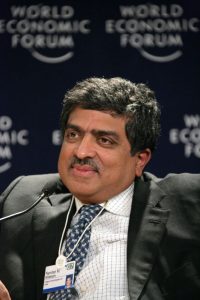
Bangalore, 1955: The Engineer’s Son
Nandan Mohanrao Nilekani was born on 2 June 1955 in Bangalore, into a Konkani Saraswat Brahmin family. His father, Mohanrao Nilekani, was an engineer with the Minerva Mills group. His mother, Durga, was a housewife. The family lived in a modest three-room flat in Bangalore’s Jayanagar.
Nandan was bright and introverted. He studied at the Bishop Cotton Boys’ School, Bangalore, and then at the St. Joseph’s High School, Dharwad, where his extended family took him in during his teenage years because his parents were moving for work. He was fourteen when he realised he wanted to study engineering. He cracked the IIT entrance exam and entered IIT Bombay in 1973, graduating with a B.Tech in Electrical Engineering in 1978.
At IIT Bombay, his roommates included a soft-spoken Tamilian named S. Gopalakrishnan — “Kris” — who would, three years later, become one of his six co-founders at a company that didn’t yet exist.
1978–1981: Patni Computer Systems
Nandan joined Patni Computer Systems in Mumbai as a graduate engineer in 1978. Patni, at the time, was India’s most respected software services firm — not for its scale (which was small) but for its hiring bar. A young, serious IIT Bombay engineer in Patni in the late 1970s was as close as India got to Silicon Valley, culturally.
His immediate boss at Patni was an intense Mysorean in his early thirties — N. R. Narayana Murthy. Murthy was Patni’s head of software development. Nandan joined his team. They did not know each other socially; Murthy was seven years older and a technical layer above Nandan. But over three years of working together on projects — mainframe migrations, banking systems, US client engagements — Murthy came to see Nandan as one of the most disciplined engineers he had ever worked with.
In July 1981, when Murthy decided to quit Patni and start his own software company, he called Nandan into a small conference room and asked him if he would like to come along.
1981: Co-Founder of Infosys
Nandan Nilekani — at 26, unmarried, earning a decent Patni salary, living in a Mumbai rental — said yes within 24 hours. He became one of the seven co-founders of Infosys, along with Murthy, Kris Gopalakrishnan, N. S. Raghavan, S. D. Shibulal, K. Dinesh, and Ashok Arora. The story of that founding — including Sudha Murty’s ₹10,000 loan — is told in an earlier lesson of this course.
Nandan’s specific role, during the first decade, was client-facing: he built Infosys’s entire US business, spending years on flights between Bangalore and Silicon Valley, Boston, and the East Coast finance hubs, painstakingly acquiring the client relationships that would eventually become Infosys’s moat. By the mid-1990s, Nandan was the face Infosys’s largest customers saw. Narayana Murthy was the CEO, but Nandan was the commercial backbone.
2002–2007: The CEO Years
In March 2002, Narayana Murthy stepped down as CEO of Infosys and moved to Chairman and Chief Mentor. The board unanimously appointed Nandan Nilekani as the new CEO. He was 47.
Nilekani’s five-year CEO tenure (2002–2007) is arguably the least glamorous — and most consequential — period in Infosys’s history. By the time he took over, Infosys had already navigated the dot-com crash, fully recovered, and was being asked by global investors and board members to do something it had never done before: scale.
Scaling an Indian IT company past $1 billion in revenue, back then, required fundamentally rebuilding the delivery model. Under Nilekani:
- Infosys opened its Mysore training campus — a 337-acre residential training facility that would, at full scale, train 14,000 engineers at a time. No other IT company globally had anything remotely comparable.
- Revenue grew from approximately $500 million in FY02 to $3.1 billion in FY07 — a 6× increase in five years.
- Headcount went from 10,000 to 72,000 in the same window.
- Infosys was the first non-banking Indian company to be listed on NASDAQ-100.
- The “Global Delivery Model” — the playbook of splitting an IT project across onshore, nearshore, and offshore teams — was, substantially, Nilekani’s doctrine. It became the template every Indian IT services company eventually copied.
By 2007, Infosys had cemented its position among India’s three big IT companies (TCS, Infosys, Wipro). Nandan handed the CEO chair over to Kris Gopalakrishnan in June 2007 and moved to Co-Chairman. He was 52.
2008: “The World Is Flat” and a Phrase That Outgrew Him
In 2004, the American journalist Thomas Friedman spent a morning at Infosys’s Electronics City campus, interviewing Nandan Nilekani. During the conversation, Nandan — explaining how a Bangalore programmer and an Iowa programmer were now competing in real time for the same job — used a phrase that Friedman would later credit as the inspiration for his book:
“Tom, the playing field is being levelled. The world, in effect, has been flattened.”
— Nandan Nilekani to Thomas Friedman, 2004
Friedman’s book, The World Is Flat, went on to sell 4 million copies and became one of the defining globalisation books of the 2000s. The phrase “the world is flat,” directly born in a Nilekani interview, spread so widely that Nandan himself — in a 2011 speech — had to gently correct it: “The world, more accurately, is flattening. It is not flat yet.”
In 2008, Nilekani’s own book, “Imagining India: Ideas for the New Century”, was released. It was a 400-page blueprint for how India could transition from a post-colonial bureaucracy to a digital-era service economy. The book was widely read in Indian policy circles. One reader, in particular, was the Finance Minister of the day — and a Planning Commission member named Montek Singh Ahluwalia.
They invited him to dinner.
2009: Walking Away From Infosys
In May 2009, Manmohan Singh’s second-term government, newly re-elected, was looking for a high-profile private-sector figure to lead a radically ambitious project: build a unique biometric identity for every resident of India. The Unique Identification Authority of India (UIDAI) would be its governing body. The project was later called Aadhaar.
The Prime Minister’s offer to Nandan Nilekani was direct: come in as the first Chairman of UIDAI, with Cabinet rank. Build the stack. The scope was something no country had ever attempted: 1.2 billion people, biometric-plus-demographic records, a unique 12-digit number issued to every resident, and a real-time verification infrastructure that any private or public service could plug into.
Nandan, after a single weekend of discussion with his wife Rohini, said yes. He resigned as Co-Chairman of Infosys in July 2009. He took the UIDAI job at a symbolic ₹1-a-month salary. He moved to Delhi.
He was, at the time, a billionaire on paper (his Infosys stake was worth roughly $1 billion). He had given up what every Indian CEO dreams of — a settled board role at one of the three great IT companies — for a government job that most senior officials in Delhi privately predicted would collapse within two years.
Building Aadhaar: The Impossible Infrastructure
Between 2009 and 2014, Nandan Nilekani ran UIDAI from a small, sparse office in Delhi’s Jeevan Bharti Building. His team, at peak, was around 100 people. Most of them were IT engineers, not bureaucrats. Nandan deliberately kept the office lean because he wanted the technology decisions to be the centre of the project, not the procedural overhead.
The architecture decisions made in that room would, in retrospect, become one of the most important pieces of public digital infrastructure in human history:
- Biometric-first identification. Fingerprints and iris scans, not just photographs. This was controversial at the time; Nilekani’s team argued that for a country with endemic name-spelling ambiguity, biometrics were the only robust primary key.
- Open API architecture. Aadhaar’s authentication was a simple REST-like API that any service — banks, telecom, government — could use. It made identity verification take 2 seconds instead of 2 days.
- e-KYC layer. A mobile phone company or bank could, with the user’s consent, pull verified demographic data from Aadhaar instantly — collapsing the paper KYC process that had historically cost Indian banks ₹500–1,000 per customer.
- DBT integration. Direct Benefit Transfer — the replacement of leaky subsidy chains with direct money transfers to Aadhaar-linked bank accounts. The Economic Survey would later estimate that DBT, enabled by Aadhaar, saved the Indian government over ₹2 lakh crore in leakage and fraud over its first decade.
By March 2014, when Nilekani stepped down, UIDAI had enrolled over 600 million Indians. By 2016, over 1 billion. By 2024, the number stood at over 1.38 billion — essentially every Indian adult, plus nearly every child born since 2011.
Aadhaar became, in the words of the World Bank, “the most ambitious digital identity project ever undertaken by a single nation, successfully.”
2014: A Failed Run for Parliament
In 2014, Nilekani contested the Lok Sabha elections from the Bangalore South constituency on a Congress ticket. He ran — visibly, deliberately — as a technology-policy candidate in a year where the national wave was decisively in favour of Narendra Modi’s BJP. He lost to Ananth Kumar by around 230,000 votes.
He took the loss gracefully. In his concession speech, he said the Aadhaar work had been the privilege of his life, and he had nothing to regret about running for Parliament either. His wife, Rohini Nilekani — a journalist and philanthropist in her own right, who had founded the children’s-books publisher Pratham Books — later said that his political loss had quietly relieved her. She had been worried, she said, about him spending the next twenty years of his life in Delhi’s corridors rather than in “anywhere that makes actual things.”
2014–2017: The In-Between Years
Between 2014 and 2017, Nilekani returned to his intellectual life. He and Rohini founded EkStep, an education non-profit aimed at helping Indian children below class 5 acquire core numeracy and literacy. He became involved with iSPIRT, a think tank that was turning Aadhaar’s open APIs into a broader “India Stack” — including Unified Payments Interface (UPI), DigiLocker, and eSign.
He also gave away money — a lot of it. By 2023, the Nilekani family had publicly pledged over half their net worth to philanthropy, joining Bill Gates and Warren Buffett’s Giving Pledge in 2017.
August 2017: The Phone Call
On 17 August 2017, Infosys’s non-founder CEO Vishal Sikka resigned in the middle of a public governance dispute. The Infosys stock dropped 10% in a single session, erasing over ₹30,000 crore of market capitalisation. The board, meeting in emergency session, asked who could stabilise the company.
Three names were floated. Two — a former US CEO and an external candidate — expressed reluctance. The third was Nandan Nilekani. He was 62, retired in spirit if not in body, active with EkStep, comfortable with his post-government life, and had explicitly said in 2014 that he was done with corporate operations.
The phone call was made by Murthy himself. The ask was blunt: “We built this company together. It needs you now.”
Nandan agreed within 48 hours. He took the non-executive Chairman role at Infosys at a ₹1 annual salary and no stock options. Over the next twelve months, he:
- Stabilised the board and communication with shareholders.
- Hired Salil Parekh from Capgemini as the new CEO.
- Re-established the founder-board relationship without ever re-litigating the prior governance dispute.
- Restored employee confidence with calm, frequent, plain-language internal town halls.
By late 2018, Infosys stock had recovered fully, and by 2020 the company was back at record market cap. Nandan, characteristically, did not take credit. He remained non-executive Chairman through 2024 — a role whose symbolic importance to the Indian IT industry far exceeded its boardroom formalities.
The Aadhaar Stack: What He Actually Built, in Plain Numbers
- 1.38 billion Indians with an Aadhaar number as of 2024
- UPI now processes over 14 billion transactions a month — more than Visa and Mastercard combined for the Indian market, nearly all of it going through the free, government-run rails that Aadhaar and e-KYC made possible
- Direct Benefit Transfer has moved over ₹34 lakh crore of subsidies directly to beneficiary accounts since 2013
- India’s account-holding penetration went from 35% of adults in 2011 to over 80% in 2021, largely driven by Jan Dhan Yojana + Aadhaar + mobile — the “JAM trinity” that Nandan architected one third of
- The World Bank estimates that Aadhaar + DBT save the Indian exchequer $34 billion per year in leakage prevention alone
It is the rare case of a single individual’s technology choices, made in a small Delhi office over five years, directly shaping the economic architecture of the sixth-largest economy on earth.
The Personal Wealth, Deliberately Under-Discussed
Nandan Nilekani is, by 2024 disclosed Forbes numbers, worth approximately $3.1 billion — most of it in Infosys equity, with meaningful additional stakes in EkStep-related ventures and various private investments. He has never been photographed on a yacht. He has not bought a sports team. He drives — reportedly still — the same car he drove a decade ago. His office at the Nilekani Philanthropies headquarters is described as “a quiet room with many books and no ego.”
His wife Rohini, through the Nilekani Philanthropies, has separately built one of the largest and most thoughtful social sector philanthropy portfolios in India — across environmental conservation, access to justice, early childhood education, and mental health. She has publicly said that she considers Nandan’s public-service years the happiest of their 45-year marriage.
Lessons From the Man Who Kept Starting Over
- Career is a sequence of rooms, not a ladder. Nandan left Patni for Infosys, left Infosys for UIDAI, left UIDAI for philanthropy, and came back to Infosys when asked. At no point did he treat his past role as an entitlement to his next.
- Public infrastructure is the highest-leverage work a private-sector mind can do. Aadhaar alone moved more Indians out of poverty, faster, than any two corporate initiatives of the same era. The impact-to-effort ratio of public digital infrastructure dwarfs almost any private-sector compounding story.
- Boring is the feature, not the bug. Nandan’s ethos — at Infosys, at UIDAI, now at Nilekani Philanthropies — is determinedly unflashy. It is the ethos that scales to a billion users.
- Philanthropy starts while you are building, not after. The Nilekanis began giving substantially in 2001, when their wealth was perhaps 5% of its eventual peak. Most Indian promoters wait until retirement. Nandan started while still running a company.
- The best second act is to return, quietly, when called. His 2017 Infosys return was the single least self-promoted major corporate intervention in India’s 21st century. He arrived, fixed what was broken, and left the credit to the incoming CEO.
A Morning in 2024
It is early 2024. A 69-year-old man in a plain white shirt and cotton trousers is sitting at a small round table in Bangalore, drinking filter coffee and reviewing a 30-page proposal from EkStep on scaling the Digital Public Goods framework to Africa. The coffee is strong. The proposal is dense. His daughter’s painting, framed on the wall behind him, is the only decoration in the room.
On his desk sits a small printed note from a colleague at UIDAI, dating back to 2011. It says, in Nandan’s own handwriting: “Whatever we build must work at 1.2 billion. Otherwise it is a toy.”
The second-biggest identity system in the world is called Social Security, in the United States. It has been under construction for 85 years and serves around 180 million people. The largest identity system in the world is Aadhaar. It was largely built in five years, in Delhi, by a team the man in the white shirt once led.
He rinses his coffee cup, puts the proposal in a brown folder, and heads back to his meeting. Another room. Another thing to build.