
Rakesh Jhunjhunwala — The ₹5,000 Boy Who Bought India

In 1985, a 25-year-old chartered accountant in Bombay walked into the BSE with ₹5,000 borrowed from his brother and the permission of a father who did not approve. Thirty-seven years later, the same man would die overnight in his sleep in a Malabar Hill flat, leaving behind a portfolio worth over ₹40,000 crore, a commercial airline in pre-launch, and a country that had — partially through his example — discovered that it could own its own businesses.
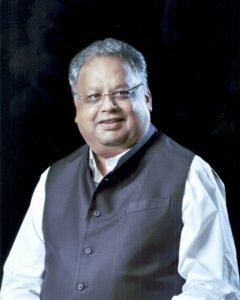
The Income Tax Officer’s Son Who Bought Dalal Street
Rakesh Radheshyam Jhunjhunwala was born on 5 July 1960 in Hyderabad into a middle-class Marwari family. His father, Radheshyam Jhunjhunwala, was an officer in the Income Tax Department — a posting that moved the family to Mumbai when Rakesh was still a child. The young Rakesh grew up in a small flat in Dadar Parsi Colony, went to Sydenham College, qualified as a Chartered Accountant in 1984 at age 24, and promptly told his father that he did not want to practice accountancy.
“I want to play the market,” he said.
Radheshyam Jhunjhunwala — a meticulous, by-the-book civil servant — was horrified. He told his son that he could do whatever he wanted, but that he would never borrow from his father or take a single rupee from his own pension. Rakesh would have to fund his own experiment in speculation, with his own money, and face his own consequences.
Rakesh accepted. He had exactly ₹5,000 of his own savings. His elder brother Rajesh lent him approximately another ₹5,000 at a rate of 18% per annum — effectively a commercial margin loan.
With that seed, Rakesh Jhunjhunwala walked into the BSE in 1985. The Sensex, at the time, was around 150. Over the following 37 years, it would go to roughly 60,000 — a 400-bagger, before dividends. Rakesh’s own CAGR, over the same period, is estimated at 31–32% a year. If the Sensex was a 400-bagger, Rakesh was something close to a 40,00,000-bagger.
His First Trade — Tata Tea, 1986
Rakesh’s first significant holding was Tata Tea. In 1986, he bought 5,000 shares at ₹43 each — a position of ₹2.15 lakh, bigger than his starting capital because he was now actively borrowing against open positions and collecting intraday short-selling margin.
He held the position for three months. Tata Tea doubled to ₹143. He sold, walked away with ₹5 lakh in profit, and reinvested nearly all of it into Sesa Goa, the iron ore miner. Over the next eighteen months, he is said to have turned that ₹5 lakh into roughly ₹25 lakh in Sesa Goa alone.
He was twenty-six, and he had a ₹25 lakh cheque to his name. Fifteen years later, he would tell a CNBC reporter about this period in his life:
“My father had told me I would never make money this way. He was not wrong. I was very lucky, very early, on Tata Tea. Had Tata Tea not doubled in those three months, I would almost certainly have gone back to accounting. Every career is built on one or two breaks of luck. Mine was Tata Tea.”
— Rakesh Jhunjhunwala
The Titan Trade: A Fifteen-Year Hold That Built Half His Fortune
If Tata Tea gave Rakesh his start, Titan gave him his retirement.
In 2002–03, Titan Company — the Tata-group watches and jewellery business that owned Tanishq — was in what today’s financial press would call “forever underperformer” status. It had been listed for fifteen years. Its stock had gone nowhere. Management was seen as slow. The watch business was cyclical. The jewellery business was seen as margin-starved. Most institutional holders had given up.
Rakesh began quietly accumulating Titan stock in late 2002 at an average price of approximately ₹3 per share (adjusted for later splits and bonuses). He and his wife Rekha — who is his co-investor and whom many close friends credit with keeping him disciplined — built the position over fifteen months, ending 2003 with roughly 6.5 crore shares.
His public thesis, repeated on every TV panel in 2003–04, had four pillars:
- India’s aspirational middle class is about to explode. The 2001 Census had shown an emerging 200-million-strong middle class that did not exist in 1991. This group would want branded jewellery, not unhallmarked goldsmith-shop ornaments.
- Tanishq is the only pan-India branded jewellery play. There is no second national brand. The country has 12,000 listed jewellers; it will consolidate into perhaps 30. Tanishq is first.
- Gold prices are cyclically low. As gold rises, the inventory on Tanishq’s shelves revalues automatically. Jewellery retail has, built into it, a permanent long-call on gold.
- Management is respected. Xerxes Desai and later Bhaskar Bhat were old Tata group operators. “Tata-quality management trading at scrap-iron prices,” as Rakesh put it on a 2004 CNBC panel.
Between 2003 and 2022, Titan’s stock, after four bonuses and three splits, compounded at an average ~38% CAGR. Rakesh’s original ₹3-per-share cost basis was, by 2022, sitting against a market price around ₹2,800 — an almost 1,000-bagger, before dividends.
At his peak holding, Rakesh and Rekha Jhunjhunwala together owned approximately 4.5% of Titan Company, worth over ₹11,000 crore. A single stock that — on its own — was larger than the Indian equity assets of several global hedge funds.
The Trades That Didn’t Work
No honest account of Rakesh Jhunjhunwala should skip his failures, because he talked about them openly and often.
His most famous wound was A2Z Maintenance & Engineering Services, a mid-cap infrastructure services firm he had taken a large personal position in around 2010 at prices close to ₹400. A2Z never did what he expected. Between 2011 and 2016, the stock fell over 90%. Rakesh eventually exited at roughly ₹20 per share — an 85%+ drawdown on a position reportedly worth hundreds of crore at peak.
His second significant failure was in Bilcare Limited, a pharma-packaging company, where a thesis around global contract manufacturing never materialised and the stock collapsed from ₹1,000 to below ₹100 between 2010 and 2015.
Rakesh’s line on these, used repeatedly on CNBC:
“I am wrong 40% of the time. If you don’t accept this, you cannot play this game. The trick is to be wrong on a smaller amount of capital than you are right on.”
— Rakesh Jhunjhunwala
The honesty was disarming. Most Indian investors, before and since, treat a bad trade as a reputational event to be buried. Rakesh treated it as teaching material.
His Mentor: Radhakishan Damani
A central, under-discussed feature of Rakesh’s career is his lifelong friendship with Radhakishan Damani — the media-shy founder of DMart and, in the mid-1990s, one of the largest stockbrokers on the BSE. (Damani has his own lesson in this course.)
Damani is, by Rakesh’s own account, the man who taught him how to short. Their famous collaboration was the 1992 short against Harshad Mehta’s ACC trade. While Mehta was walking the cement stock from ₹200 to ₹9,000, Damani and Rakesh — convinced that the move was being funded by stolen bank money — took massive short positions. When the scam was exposed and the stock collapsed, both men made their first truly serious fortunes.
Rakesh’s short against ACC in 1992 is said to have netted him over ₹2 crore — at a time when his total portfolio was still under ₹1 crore. It gave him the capital he would use, through the rest of the 1990s, to build his core long positions.
Damani and Jhunjhunwala remained close for the rest of Rakesh’s life. They famously never invested together directly (they had different styles) but their conversations in Damani’s Altamount Road office are said to have shaped a generation of Indian investing careers.
The Companies Rakesh Built (Not Just Bought)
Rakesh was not only a public-market investor. He held board seats, private-market stakes, and — especially in the last decade of his life — he actively helped build companies. Some highlights:
- Aptech — an IT training franchise he took over in 2005 and restructured for a decade. Never became the superstar he had hoped, but was profitable.
- Star Health & Allied Insurance — a private stake he led the consortium for, eventually taken public. Several hundred crore realised gain for him personally.
- Nazara Technologies — the mobile gaming company. Rakesh was a 10% shareholder. It listed in 2021 at a strong premium.
- Akasa Air — the most theatrical of them all. Rakesh, at age 62, publicly announced in 2021 that he was funding a new low-cost airline called Akasa. At the time, Indian aviation was famous for making fortunes disappear. Air Deccan had died. Kingfisher had died. Jet had died. Friends asked him why he, of all investors, would launch an airline. His answer, on camera:
“I was afraid of success — and I wanted to see if I could be a businessman, not just a businessman’s shareholder. Airlines are the hardest business. If I can build one, I can retire.”
— Rakesh Jhunjhunwala, 2021
Akasa Air’s first commercial flight, Mumbai to Ahmedabad, took off on 7 August 2022. Rakesh, in failing health, sat in a wheelchair at the departure gate and waved the crew off. He told the captain it was the happiest morning of his life.
Seven days later, he was gone.
14 August 2022
Rakesh Jhunjhunwala died in the early hours of 14 August 2022, at his Malabar Hill flat in Mumbai. Cause of death: cardiac arrest. He was 62 years old.
India woke up the next morning — Independence Day — to an avalanche of obituaries. The Sensex, when it opened on 16 August, surprisingly rallied (as it often does after the death of a perpetually bullish investor, in a wry tribute).
His estate, at death, was valued at approximately ₹46,000 crore — roughly $5.5 billion. The single largest self-made, stock-market-only fortune in Indian history. For context: Rakesh left the world roughly 90,00,000 times the ₹5,000 he started with in 1985.
The Discipline Behind the Theatrics
What people saw of Rakesh Jhunjhunwala on television — the red kurtas, the open-collared whisky glass, the unsparing one-liners, the laughter that took over the studio — hid a much more disciplined investor than the persona suggested. Close associates have described his daily routine:
- Morning: he read the annual reports of every major holding, cover to cover, every quarter. Not summaries. Not the MD&A. The full document, including the auditor’s letter.
- He kept a running list of what could go wrong. For every position, Rakesh maintained what he called his “why I’m wrong” sheet — the two or three things that could collapse the thesis. He would update it after each quarterly result.
- He never used stop-losses on long positions. But he never added to a losing long position either. “If the thesis is broken, the thesis is broken. Don’t sell. But don’t lie to yourself by doubling down.”
- He was fanatical about position sizing. At no point in his career — even at peak — was any single stock over 30% of his portfolio. Titan came close; he deliberately capped further purchases to protect the concentration.
- He paid meticulous attention to taxes. His portfolio turnover was among the lowest in the Indian market. Long-term capital gains, he said, were “the second miracle of compounding, after compounding itself.”
The Jhunjhunwala Portfolio at Death (approximate)
- Titan Company — ₹11,000 crore+
- Star Health — ₹4,500 crore+
- Metro Brands — ₹3,500 crore+
- Tata Motors — ₹2,000 crore+
- Crisil — ₹1,800 crore+
- Nazara Technologies — ₹1,200 crore+
- Escorts Kubota — ₹800 crore+
- Indian Hotels — ₹1,300 crore+
- Fortis Healthcare, Jubilant Pharmova, Federal Bank, Agro Tech Foods, Aptech, Rallis India, Bilcare, VA Tech Wabag, and many others — collectively another ₹15,000 crore+.
What He Actually Believed About India
Rakesh’s famous one-line thesis, repeated from roughly 2005 onwards in every interview he ever gave:
“You can be bearish on India for thirty minutes. Not thirty years.”
— Rakesh Jhunjhunwala
He believed — deeply, and in a way most Indian investors did not in 2005 — that the country was on the verge of a compounding machine that only a handful of emerging markets had ever sustained. Domestic consumption, demographic youth, a services-led export base, and — crucially — an under-penetrated equity market where household savings would inevitably shift from gold and real estate into stocks.
Every one of those theses proved correct over his lifetime.
Lessons From the Big Bull
- Start small. Finish nowhere close to where you started. ₹5,000 to ₹46,000 crore is not skill alone. But without 37 years of disciplined reinvestment, no amount of skill gets you there.
- Concentration builds wealth. Diversification protects it. Learn when to switch modes. In his first 20 years, Rakesh made most of his money in 4–5 names. In his last 10 years, he increasingly spread risk — but never over-diluted.
- Honesty about losses is compounding. By publicly admitting A2Z, Bilcare and others, he built a body of case studies in how not to repeat mistakes. Most investors who hide their losses repeat them.
- Don’t confuse the investor with the trader. Rakesh, uniquely, ran both accounts all his life — a long-term compounding book and a speculative trading book. He was disciplined about never letting one pollute the other.
- Time in the market beats timing. But patience alone is not a strategy. Rakesh held Titan for 18 years. But he also exited A2Z in full when he realised he was wrong. Holding the right stock is the reward. Identifying the wrong stock is the job.
- Bet on the country you actually live in. Rakesh’s single biggest edge was that he believed in India when even his own financial advisors in London did not. He bought the India story when it was ₹3 a share, and he died with roughly 40% of it.
The Funeral Procession
Rakesh Jhunjhunwala’s cremation was a quiet affair at Banganga. His wife Rekha, his three children, his brother Rajesh, and about eighty close friends and colleagues attended. Radhakishan Damani was there. Nemish Shah was there. Kalpraj Dharamshi — a trader from their shared 1990s era — was there. Sanjoy Bhattacharya, an old friend, read a short passage from the Gita.
Somewhere in the small crowd was a retired chartered accountant from Borivali who had bought 100 shares of Titan in 2003 after hearing Rakesh on CNBC. He had held for 19 years. Those 100 shares were, by then, worth over ₹25 lakh. He had, he told a reporter outside the crematorium, paid for his daughter’s Boston College tuition out of a single year’s dividends.
The Big Bull, in the end, did not just build his own fortune. He funded a few hundred thousand other small ones — people who listened to him on a Tuesday evening CNBC show and took the leap.
That was always the trade he really wanted to make.